Published August 19, 2026, via Research News
Recently, an increasing number of investigators have contacted the Human Research Protection Office (HRPO) to request if the review of their IRB protocols can be expedited to reach Just-in-Time (JIT) deadlines. The HRPO understands the urgency of these notices. The following information is meant to provide clarifications on the IRB review process.
Steps involved from Just-In-Time notice to IRB approval:
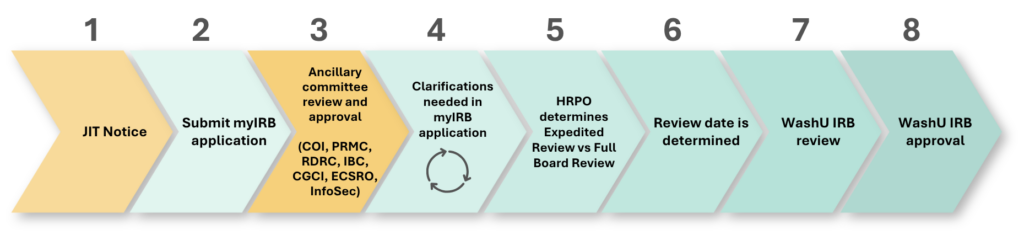
- Expedited review” is a review pathway for research protocols that are considered minimal risk. Any studies involving investigational drugs, devices, or study procedures that are considered greater than minimal risk requires IRB Full Board review. The HRPO will determine if the study can be reviewed under the Expedited Review Pathway upon submission of the IRB protocol. This determination is separate from a decision to prioritize a review to help meet JIT timelines.
- According to WashU IRB policy, review can begin only after ancillary review processes have been completed. For example, studies that involve the following may require ancillary review and approval by specialized committees before the IRB review process can be initiated (myIRB application myProject Section 4 questions will also help to determine when ancillary committee review is needed):
- Financial interest (individual and/or institutional): Conflict of Interest (COI) Review Committees
- Cancer related research: Siteman Cancer Center Protocol Review and Monitoring Committee (PRMC)
- Radioactive compounds or radiation: Radioactive Drug Research Committee (RDRC)
- Genetically modified products or infectious agents: Institutional Biological & Chemical Safety Committee (IBC)
- Genetically modified cellular products: Center for Gene and Cellular Immunotherapy (CGCI)
- Embryonic cells: Human Embryonic Stem Cell Research Oversight Committee (ESCRO)
- Digital technologies involving PHI/PII risks: Information Security (InfoSec). Sometimes the need for InfoSec review may not identified until after HRPO review begins. However, InfoSec review will still impose additional time for IRB approval, like review by other ancillary committees. For optimal efficiency, if a study team knows that InfoSec review is required, this should be obtained prior to myIRB submission.
- Note: New Investigational New Drug (IND) and Investigational Device Exemption (IDE) applications must be submitted and approved by the FDA before IRB review will occur. Amendments to FDA-approved IND or IDE protocols can be submitted to the IRB within a day after the amendment request has been received by the FDA. Include the FDA amendment application with the submission.
- Note: New Investigational New Drug (IND) and Investigational Device Exemption (IDE) applications must be submitted and approved by the FDA before IRB review will occur. Amendments to FDA-approved IND or IDE protocols can be submitted to the IRB within a day after the amendment request has been received by the FDA. Include the FDA amendment application with the submission.
- IRB protocol submission should occur as soon as possible after the JIT notice is received. The IRB cannot make up for time lost by study teams who postpone their IRB submission. In accordance with WashU IRB policy, the ancillary review processes must be completed prior to the start of IRB review. Many of the WashU ancillary review committees listed above use information provided in the myIRB application and will provide approval letters to HRPO when completed. Once approvals are received from the ancillary committee review(s), the IRB will initiate its review. Investigators who wait for the approval letter from the ancillary committees before submitting their myIRB protocol will naturally cause a delay in the overall review process.
- The timeline from submitting the study in myIRB to final IRB approval is dependent on more than just the IRB review. If ancillary committee review is required for a study, then the overall review time is also dependent upon the review times of the ancillary committees. It may be appropriate to consult with these committees to determine a realistic timeframe for their review. The IRB review timelines are considered separate from ancillary committee review timelines.
- When submitting an IRB review date for your JIT notice, it is acceptable to estimate a future date of IRB review for your JIT notice, based on the median approval timelines for IRB review. For 2025, the median time for studies that could be approved under Expedited Review was 8 days, and the median time for review of studies that required Full Board Review was 40 days. These timelines represent the median time in calendar days from the start of IRB review to the time of IRB approval. Additional time will be needed for studies that require ancillary committee review as discussed above, and investigators should consult with the ancillary review committee to estimate the final date for review. For example, if a study requires an ancillary review timeframe of 14 days, and then 40 days for IRB Full Board Review, then the sum of these timeframes (n= 54 calendar days) should be used to estimate your future date.
To optimize the efficiency for HRPO/IRB review, the following steps are recommended:
- Submit your IRB application as soon as possible after the JIT notice, even if ancillary review is required. The myIRB system will usually flag when ancillary committee review is required. If required, the IRB review will not occur until the ancillary review is completed.
- Communicate with ancillary review committee leadership to gauge their timelines for review. In this way, IRB review can commence as soon as all ancillary reviews are completed.
- Respond to requests for clarification and information from HRPO reviewers as soon as possible when your protocol is being reviewed. Watch your email closely regarding the status of your submission.
- Focus your communications with the HRPO reviewer that is assigned to your study. Reaching out to one or more individuals in HRPO who you may have worked with in previous submissions, but who are not assigned to your current protocol review, will slow down the review process and impact review timelines for other researchers. Your HRPO reviewer assignment can be found after myIRB submission.
- Avoid trying to stack funding from new research studies onto unrelated WashU IRB-approved protocols. If the Aims of your new funding do not match those of your current approved study, then a new application will be needed. Trying to circumvent the need for new protocol submission will only delay your approval process
Research protocols are becoming more complex, and the funding agencies should recognize this. If you have a JIT notice that states IRB approval is required within an unrealistic timeline and does not include the option to provide the expected date of IRB review or approval, communicate with your program officer.
- Suggested communication: The WashU IRB is reviewing the study protocol and documents for the study entitled “[study title]”. IRB approval is expected by XXX date. The IRB must be allowed sufficient time to ensure that the study complies with all human subjects oversight federal requirements before granting final approval and beginning any human subject research activities.”
If you are unable to come to a resolution with your program officer or funding agency, contact the Executive Chair of the IRB, Derek Byers, dbyers@wustl.edu, and the Executive Director of HRPO, Jeanne Velders, veldersj@wustl.edu. Be prepared to provide documentation that clearly states IRB approval is required with no exceptions. This includes the JIT documentation and communications from the program officer.
Resources: